
On this page
Guelph is working on ways to use energy more wisely and reduce our carbon emissions in order to fight climate change.
Community Call to Climate Action
Our Community Call to Climate Action shares key steps we must take to reach net zero by 2050. It includes actions we can take today to support cleaner air, healthier homes and a stronger local economy in the future.

Community Call to Climate Action

Community Call to Climate Action: Backgrounder
Guelph’s Race To Zero to become a net zero carbon community by 2050
The City of Guelph is committed to the United Nations Race To Zero campaign and has set targets for the whole community to reduce carbon emissions:
- Reduce our community carbon emissions by 63 per cent against the 2018 baseline by 2030
- Work together to become a net zero carbon community by 2050
We encourage all people, businesses and organizations in the community to help conserve energy and reduce their emissions and become a net zero carbon community by 2050.
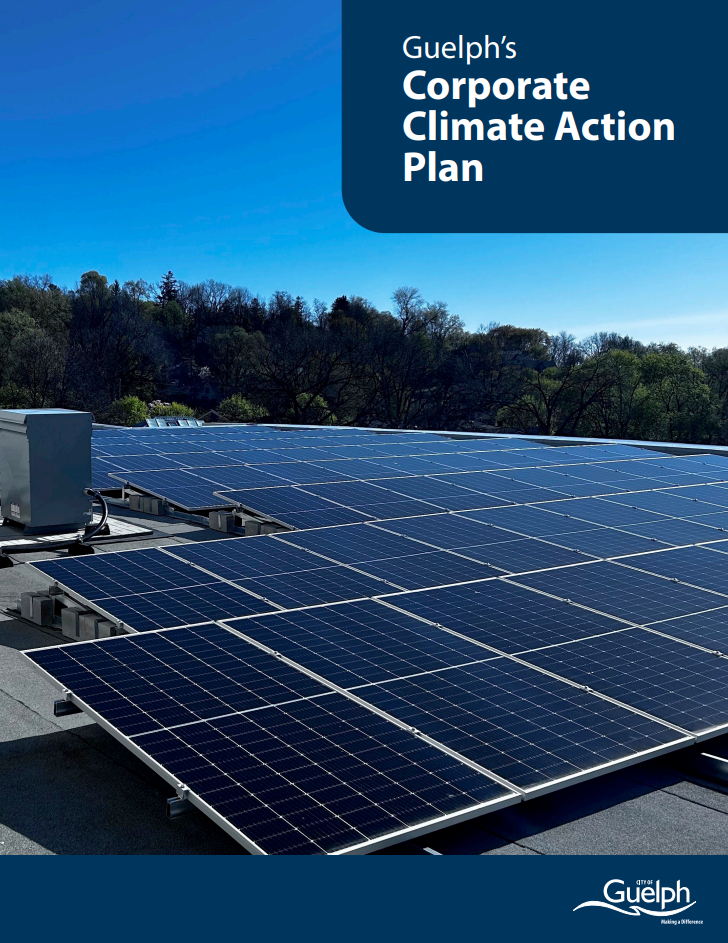
Guelph’s Corporate Climate Action Plan
The corporate action plan outlines five areas where the City can take action to cut more than 10,000 tonnes of GHG emissions from municipal operations by 2035:
- Low emission fleet vehicles: Replacing aging gas-powered City buses and vehicles with electric models and exploring low-emission options for waste collection.
- Energy-efficient process equipment: Modernizing solid waste and wastewater systems to cut energy use and expanding renewable energy production.
- Renewable energy generation: Installing more rooftop solar on City buildings and exploring a large-scale solar project at the Eastview landfill.
- High-performance buildings: Completing deep energy retrofits and constructing new municipal buildings to meet zero-carbon standards.
- Policies and standards: Strengthening corporate energy management standards, including maintaining the City’s ISO 50001 certification and developing consistent building temperature standards.
Corporate Climate Action Plan
Community greenhouse gas (GHG) tracking
Yearly community GHG emissions


Guelph’s Community Race To Zero carbon emissions target is to
- Reduce our community carbon emissions by 63 per cent against the 2018 baseline (or down to 344,048 tonnes of carbon dioxide equivalent) by 2030
Guelph’s 2022 community GHG emissions were 835,014 tonnes of CO2e. This equates to 5.71 tonnes of carbon dioxide equivalent per person in Guelph. Past years community GHG emissions were:
- 2018: 902,152 tonnes of carbon dioxide equivalent)
- 2019: 910,226 tonnes of carbon dioxide equivalent
- 2020: 749,342 tonnes of carbon dioxide equivalent
- 2021: 772,768 tonnes of carbon dioxide equivalent)
- 2022: 835,014 tonnes of carbon dioxide equivalent)
To get to Guelph’s Race To Zero, we would have liked community GHG emissions to be:
- 2019: 854,789 tonnes of carbon dioxide equivalent
- 2020: 807,426 tonnes of carbon dioxide equivalent
- 2021: 760,063 tonnes of carbon dioxide equivalent
- 2022: 712,700 tonnes of carbon dioxide equivalent
How different sector GHG emissions contribute to the total community GHG emissions

This is how different sector greenhouse gas (GHG) emissions contribute to the total community GHG emissions:
- Residential buildings (Includes fugitive emissions from oil and natural gas systems): 181,196 tonnes of carbon dioxide equivalent CO2e; 21.7%
- Institutional/Commercial buildings (Includes fugitive emissions from oil and natural gas systems): 191,831 tonnes of CO2e; 23.0%
- Industrial buildings (Includes fugitive emissions from oil and natural gas systems): 183,911 tonnes of CO2e; 22.0%
- Transportation: 261,000 tonnes of CO2e; 31.3%
- Waste and wastewater: 17,077 tonnes of CO2e; 2.0%
The three maps below are a graphical representation of annual greenhouse gas emissions in Guelph’s residential, commercial, and industrial sector respectively. The emissions are shown from the year 2018 (selected as baseline year) to 2022 (latest year for which information is available). The maps show six sections representing the first 3 digits of the postal code.
Residential GHG Emissions 2018-2022
View full-screen residential map
Commercial GHG Emissions 2018-2022
View full-screen commercial map
Industrial GHG Emissions 2018-2022
View full-screen industrial map
More ways Guelph is responding to climate change
In addition to using less fuel and energy to reduce greenhouse gas emissions, Guelph is working to ensure our community is prepared to withstand and recover from the effects of climate change, by developing a Climate Adaptation Plan.
City facilities, fleet and operations to use 100 per cent renewable energy by 2050 (100RE Target)
Currently, a quarter of all the energy used by the City facilities, fleet and operations comes from renewable sources. By further conserving energy and choosing cleaner sources, we’re planning to reduce our carbon emissions and use 100 per cent renewable energy by 2050.
100RE status


- In 2018, 23.5% of all the energy used by the City facilities, fleet and operations was from renewable sources.
- In 2019, 24.5% of all the energy used by the City facilities, fleet and operations was from renewable sources.
- In 2020, 25.4% of all the energy used by the City facilities, fleet and operations was from renewable sources.
- In 2021, 24.7% of all the energy used by the City facilities, fleet and operations was from renewable sources.
- In 2022, 24.6% of all the energy used by the City facilities, fleet and operations was from renewable sources.
- In 2023, 20.8% of all the energy used by the City facilities, fleet and operations was from renewable sources.
Corporate energy consumption


In 2023, total corporate energy consumption was 133,987,329 kilowatt hour equivalent. This works out to 904 kilowatt hour equivalent per person in the community. The composition of the total corporate energy consumption is:
| Energy type | Consumption |
|---|---|
| Vehicles propane | 0.1% |
| Facilities propane | 0.1% |
| Facilities district energy | 1.9% |
| Vehicles gasoline | 5.9% |
| Facilities digestor gas | 7.1% |
| Facilities natural gas | 21.5% |
| Vehicles diesel | 29.1% |
| Facilities electricity | 34.5% |
- In 2018 the total corporate energy consumption was 159,431,076 kilowatt hour equivalent.
- In 2019 the total corporate energy consumption was 156,908,444 kilowatt hour equivalent.
- In 2020 the total corporate energy consumption was 137,384,617 kilowatt hour equivalent.
- In 2021 the total corporate energy consumption was 138,603,869 kilowatt hour equivalent.
- In 2022 the total corporate energy consumption was 146,051,795 kilowatt hour equivalent.
- In 2023 the total corporate energy consumption was 133,987,329 kilowatt hour equivalent.
Corporate greenhouse gas (GHG) emissions


In 2023, the total corporate GHG emissions were 18,346 tonnes of carbon dioxide equivalent. This works out to 0.124 tonnes of carbon dioxide equivalent per person in the community. The composition of the total corporate GHG emissions are:
- Fleet – 62.3% or 11,424 tonnes of carbon dioxide equivalent.
- Facilities – 37.7% or 6,922 tonnes of carbon dioxide equivalent.
- In 2018 the total GHG emissions were 19,624 tonnes of carbon dioxide equivalent.
- In 2019 the total GHG emissions were 19,777 tonnes of carbon dioxide equivalent.
- In 2020 the total GHG emissions were 17,082 tonnes of carbon dioxide equivalent.
- In 2021 the total GHG emissions were 17,701 tonnes of carbon dioxide equivalent.
- In 2022 the total GHG emissions were 19,049 tonnes of carbon dioxide equivalent.
- In 2023 the total GHG emissions were 18,346 tonnes of carbon dioxide equivalent.
- 2024 Environmental Sustainability Report
- City of Guelph energy consumption and greenhouse gas emission (2011 to 2019)
- Corporate Energy Management Policy
The City also offers several rebates and incentives to help the community do it’s part to use less water, to use less energy, and to fight climate change
Learn more and get involved at guelph.ca/environment.
For more information
Energy and Climate Change
519-822-1260 extension 2672
[email protected]