
On this page
At a Glance
- A Community Planning Permit System, or CPPS, is a land-use planning tool that streamlines the review process from ~180 days to ~45 days.
- A CPPS allows for taller buildings with added community benefits, such as affordable housing or other benefits identified by the City.
- A CPPS applies to two areas in Guelph: the Stone Road and Edinburgh Road area and Downtown Guelph.
About the Community Planning Permit System (CPPS)
A Community Planning Permit System is an innovative land use planning tool designed to support affordable housing and help housing reach the market more quickly.
It combines zoning bylaw amendments, minor variances and site plan approvals into a single, more efficient approvals process.
It also addresses local needs — such as affordable housing, diverse housing types, public facilities, parks and open spaces — to support our growing city.
The Community Planning Permit System is one of the many ways that we’re helping make housing more affordable in Guelph. It is one of the actions in our Housing Affordability Strategy and is funded by the federal government’s Housing Accelerator Fund, which aims to boost local housing supply.
Where Does It Apply
The Community Planning Permit Bylaw applies to two areas in Guelph: 1) the Stone Road and Edinburgh Road modified Strategic Growth Area and 2) the Downtown Secondary Plan area. Both are outlined in the maps below:
Stone Road and Edinburgh Road CPPS
Downtown CPPS
As of August 2026, the Downtown Community Planning Permit Bylaw is in effect in the area identified in the map above. The Ontario Land Tribunal (OLT) decision motion revises the CPP Bylaw boundary to remove lands that are being studied because they are located within a floodplain (referred to as Special Policy Area Floodplain). Once this study is complete, the City will reassess whether these lands should be included in the Downtown CPP area through a separate process. The bylaw’s affordable housing provisions under Section 1.14.6 (facilities, services and matters) remain under appeal with the Ontario Land Tribunal. We will share more details following the OLT’s decision in the coming months.
Benefits
Here are some of the benefits you can expect under the Community Planning Permit Bylaw:
- Streamlined approvals for development projects: The new bylaw combines zoning bylaw amendments, minor variances and site plan approvals into a single, more efficient approvals process. This will help streamline the review process from about 180 days down to about 45 days.
- Taller buildings with added community benefits: The CPPS bylaw implements the new Downtown taller building heights Council approved in April. The new bylaw may allow developments to reach up to 24 storeys (in the approved areas) without the need for a Council hearing.
To build at these new heights, builders must include affordable housing or other needs identified by the City as part of the project.
Steps to Complete a Development Application
Here are the steps to complete a development application under the Community Planning Permit Bylaw.
Note: Steps may vary, depending on the class and variation of your project.
- Attend pre-consultation with the City.
- Submit complete Community Planning Permit application.
- Work with staff during review period. Obtain conditional approval or approval without conditions. ~45 days
- Apply for building permit. ~10-30 days
- Start building.
Types of Applications
There are three classes of applications under the Community Planning Permit (CPP) Bylaw. All applications are subject to the 45-day decision period.
Note: Class 2 and 3 applications will be required to address variation criteria and will be subject to alignment with the Official Plan, as amended, provincial policy and other applicable legislation.
Class 1:
- Meets all development standards of the bylaw.
- No variation is required.
- Includes permitted use.
Class 2:
- Application generally meets the intent, standards and provisions of the bylaw, but requires a staff variation.
- The variation should:
- Be within established threshold for development standards outlined in Section 6 of the CPP bylaw.
- Include a listed discretionary use (Table 6.1 of the bylaw).
- Be a variation to standard in Section 4: General provisions, Section 5: Parking, Section 6: Development Standards, or Section 7: Site-specific in the CPP bylaw.
Class 3:
- Application generally meets the intent, standards and provisions of the bylaw but requires a Council variation:
- Beyond established threshold for development standards outlined in Section 6 of the CPP bylaw; and/or
- Proposes an alternative facilities, services or matters contribution (see Section 1.4.6 of the bylaw).
Resources
Community Planning Permit Bylaw
- Read the full Stone Road and Edinburgh Road Community Planning Permit Bylaw.
Educational Booklet
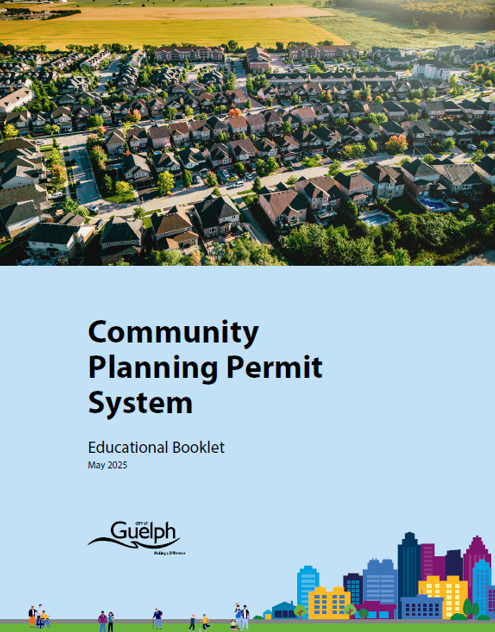
Our Educational Booklet provides an overview of a Community Planning Permit System and how it works in Guelph. It outlines how it differs from the City’s Zoning Bylaw, when a CPPS is required, what’s involved in the process and more.
Contact
Questions? Please reach out to:
Will Gregory, Project Manager
Planning and Building Services
519-822-1260 extension 4236
[email protected]